Small black horizontal line on a white background

PARKING GARAGE CLEANING

The American Concrete Institute is specific about this: road salt accumulates in a garage over the winter and should be removed each spring by flushing the deck with large volumes of water at low to moderate pressure, with a second washdown recommended in the fall. Metro Mobile Pressure Washing carries out parking garage cleaning on decks, ramps, stairwells, and service areas across Fort Washington, MD, working level by level so the structure stays open and usable throughout the work.
Construction workers pouring concrete at a building site, with a truck in the background
Wet concrete pouring from a truck chute onto a construction site, forming a gravelly slab surface

SALT DOES NOT LEAVE A GARAGE ON ITS OWN.

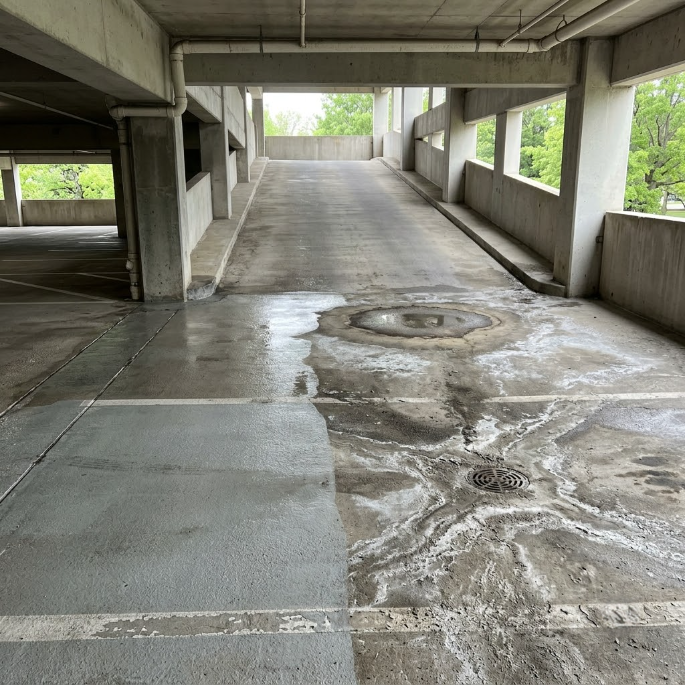
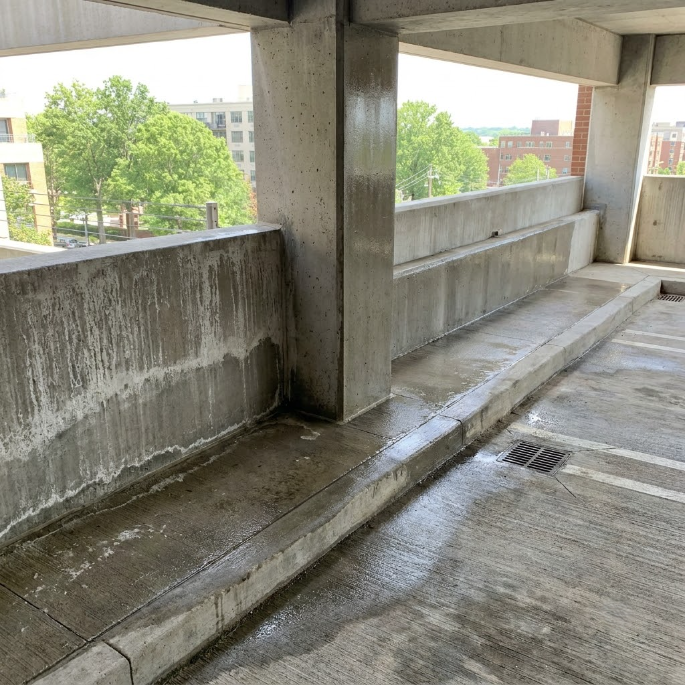
Rain never reaches most of a parking structure. Everything that arrives on a tire in January stays exactly where it dropped until somebody removes it deliberately. That is the fundamental difference between a garage deck and any outdoor slab, and it is why a structure that is never flushed carries years of accumulated chloride.

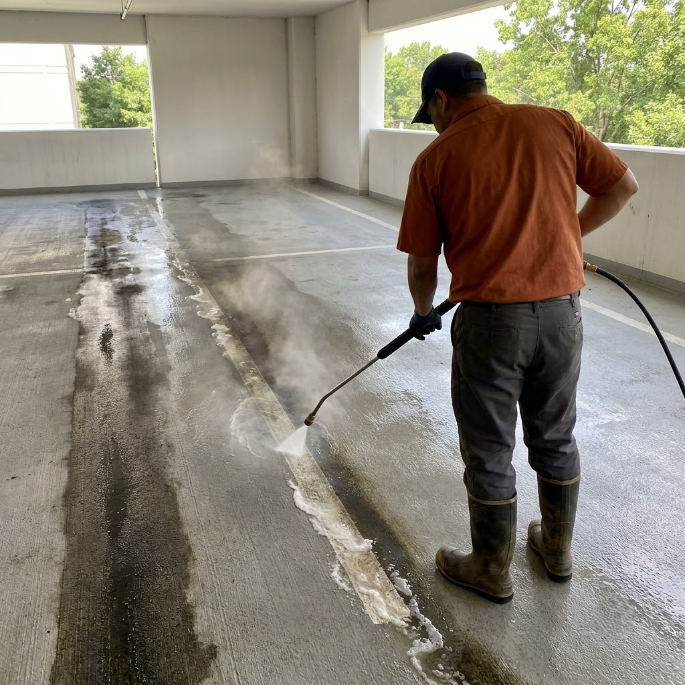
A washdown is the only mechanism for getting it off. High volume, moderate pressure, and a sensible route around joints and drains is what the published guidance describes, and it works.

  • Spring and fall flush cycles
  • High volume at moderate pressure
  • Care around joint sealants and coatings
  • Level-by-level scheduling that keeps ramps open
Black horizontal line on a white background
PARKING GARAGE CLEANING

WHAT SITS ON THE DECK ENDS UP IN THE CONCRETE.

Chloride from road salt works down through the slab until it reaches the reinforcing steel and destroys the passive layer protecting it. The steel then corrodes, and corrosion products take up more room than the metal they replaced. That internal pressure is what causes the cracking, delamination, and spalling that turns a maintenance item into a structural repair bill. None of that is visible until it is expensive.

EVERY CAR ENTERING IN JANUARY BRINGS SALT WITH IT.

Maryland's highway agency puts hundreds of thousands of tons of salt and well over a million gallons of brine onto the roads in a single season. A share of that comes into every structured parking deck in this county on wheel wells and undercarriages. It drops in the drive lanes, on the ramps, and in the stalls, and then it simply waits there.

SALT IS THE ENEMY WE HAVE FOUGHT THE LONGEST.

Concrete cracks for many reasons, but in this region the one that keeps showing up is chloride. We have seen what a deck looks like after a decade of winters with no flushing, and we have seen how much better a structure holds up when someone commits to spring and fall cycles. Across 26 years that contrast has been consistent. When was your deck last given a proper flush?

WHY CHOOSE US FOR PARKING GARAGE CLEANING.

Hand washing a car under running water, black outline icon
CHLORIDE OFF THE SLAB EACH SPRING
The single most useful thing anyone does for a parking structure is flushing the winter's salt off before summer. It is inexpensive maintenance measured against the repairs it postpones.
Hand spraying water over a car illustration, suggesting car washing or cleaning
A STRUCTURE THAT AGES SLOWLY
Deck repairs are disruptive, expensive, and always arrive at the wrong time. Regular washdowns are the cheapest available lever on how quickly a garage moves toward that point.
Hand using a spray nozzle to wash a car with water droplets around it
JOINTS AND COATINGS LEFT ALONE
Expansion joints, sealants, and traffic coatings are damaged easily by careless pressure. Working around them deliberately protects systems that cost far more to replace than the cleaning did.
Hand spraying foam over a car, suggesting washing or cleaning.
A GARAGE THAT STAYS OPEN
Level-by-level sequencing means tenants and visitors keep parking throughout. Closing an entire structure is rarely necessary and it is the fastest way to generate complaints for a property manager.
Hand washing a car with soap and water spray in black-and-white icon style
DRAINS THAT ACTUALLY DRAIN
Deck drains fill with grit, wrappers, and sediment until water begins to pond. Clearing and flushing them is part of the wash, because standing water is what accelerates everything else.
Hand spraying cleaner onto a car, with bubbles and water splashes
A DECK NOBODY COMPLAINS ABOUT
Dark, oily, dusty parking levels shape how a whole building is judged, particularly by prospective tenants. A clean, well-lit deck reads as a property that is genuinely being looked after.
Short black horizontal line on a white background

our services

OUR PARKING GARAGE CLEANING WORK
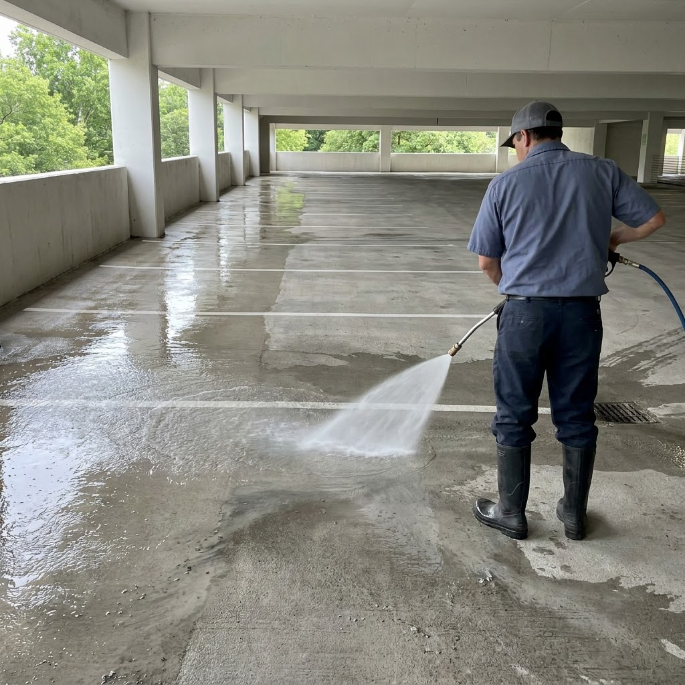
A parking structure is a collection of very different surfaces with different problems. These are the areas we address on a full washdown, whether the job is seasonal or part of a standing program.
Template premium 99
Full Deck Washdown

DECK FLUSHING


Drive lanes, stalls, and ramps flushed with high volume and moderate pressure, level by level. This is the core service and the one that carries the accumulated chloride off the slab and out through the drains.
Template premium 99
Entrances, Ramps, and Ponded Areas

HIGH LOAD AREAS


Entries, exits, and any flat or ponding section collect the heaviest salt buildup and benefit from more frequent attention. These get treated as their own zones rather than absorbed into the general pass.
Template premium 99
Drip Line and Stall Treatment

STALL DEGREASING


The dark stripes down the center of every stall are years of accumulated drips. Degreaser and heat lift what has soaked in, and long-standing marks lighten substantially rather than disappearing completely.
Template premium 99
Columns, Bumper Walls, and Curbs

VERTICALS


Vertical surfaces take splash from passing vehicles all winter, which puts salt water where nobody looks for it. Columns, bumper walls, and curb faces get washed alongside the deck itself.
Template premium 99
Drain and Trench Cleaning

DRAINAGE


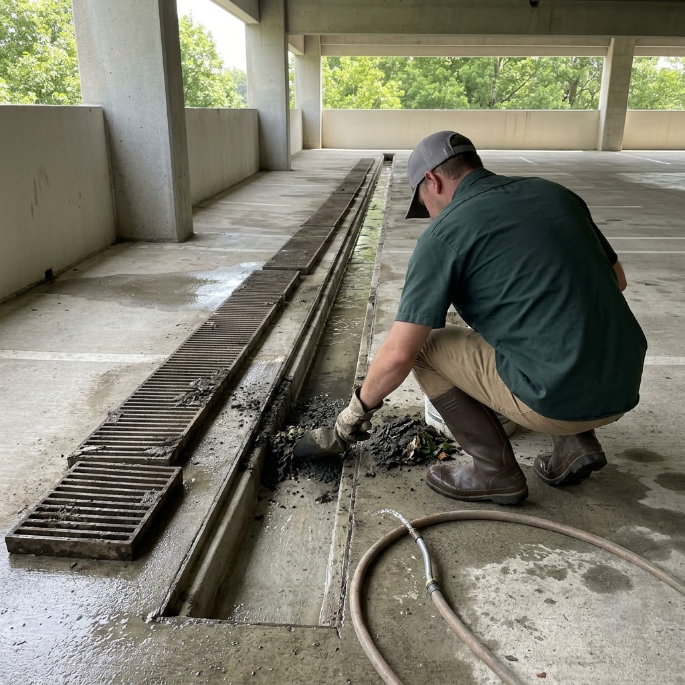
Deck drains, trench grates, and catch basins cleared of grit and debris. Flushing is done carefully so sediment is removed rather than driven further into the drainage system where it will settle.
Template premium 99
Stairwells and Elevator Lobbies

STAIRS AND LOBBIES


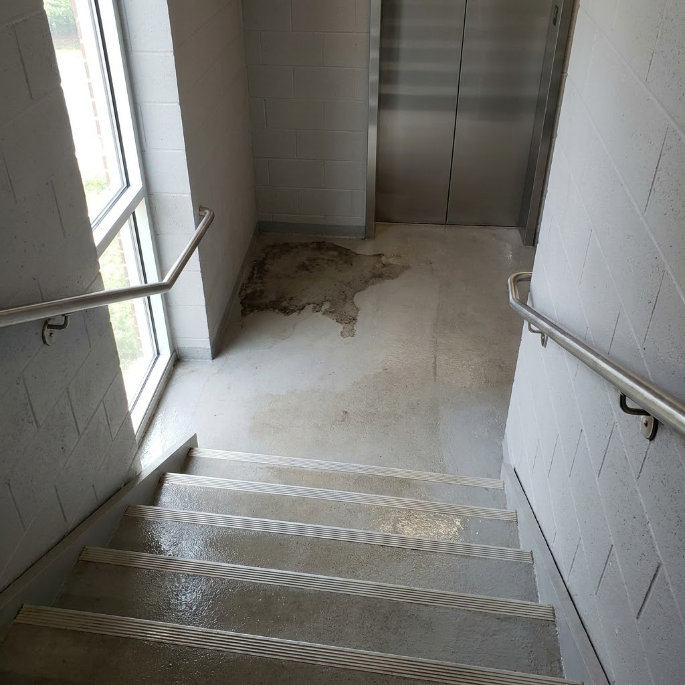
Stair treads, landings, handrails, and lobby floors, which are the parts that every tenant actually walks through daily. They also collect odors and staining that the open deck never really does.
A short black horizontal line on a white background.

THE WORD ON OUR WORK

WHAT OUR CLIENTS SAY.

Property managers tell us the useful part is that the garage stayed usable while we worked and that tenants barely registered the disruption. The second comment is usually about the difference in the stairwells, which nobody expects to notice as much as they do.
Black horizontal line on a white background
FAQ

FREQUENTLY ASKED QUESTIONS.

Garage questions come almost entirely from property managers and engineers, and they focus on frequency, disruption, and whether the cleaning can harm the structure. Here are the usual ones.

    How often should a parking garage be pressure washed?

    Industry guidance points to twice a year, in spring and again in the fall, with once annually as the practical minimum. Entrances, ramps, and areas that pond water generally justify a shorter interval than the rest of the deck.


    Does the garage have to close during cleaning?

    No. Work is sequenced level by level and section by section, so parking stays available for tenants throughout the job. Metro Mobile Pressure Washing coordinates signage and timing with management on every structure it cleans in Fort Washington, MD.


    Can pressure washing damage a traffic coating or expansion joint?

    It can, which is why coatings, sealants, and joints get identified before work starts and worked around deliberately. Careless pressure on a joint sealant creates a leak into the level below, and repairs like that are genuinely expensive.


    Can old oil stains be removed from a garage deck?

    They lighten considerably, though decades of drips in the same spot rarely vanish entirely. Degreaser and heated water reach what has soaked in, but oil that has traveled deep into the pores of the slab stays where it is.


    Can salt-damaged concrete be repaired?

    Spalling and delamination are repaired by a concrete restoration contractor, not by cleaning. Washing is what slows the damage arriving in the first place, which is why it belongs in a maintenance plan rather than a repair one.


    How long does a deck take to dry after washing?

    A few hours in reasonable conditions, and longer on the lower levels where airflow is limited. Sections are reopened as they dry, so the structure never has more than a portion of its parking unavailable at any one time.


    How do you get road salt off a garage deck?

    Volume rather than force. Flushing with plenty of water at low to moderate pressure dissolves and carries the chloride away to the drains, which is precisely what published guidance on parking structures recommends. Force achieves nothing extra here.


    Will washing remove the painted stall striping?

    Not at the pressures used for a deck flush. Metro Mobile Pressure Washing keeps pressure moderate across every garage in Fort Washington, MD, and worn striping that lifts was generally at the end of its useful life anyway.

    Black horizontal rounded bar on a white background
    HOW WE WORK

    FROM TOP DECK TO LOWEST LEVEL, HERE IS HOW.

    STEP 01

    Walk the structure with management
    We identify the coatings, the joints, the drains, and the areas that pond, then agree how the levels will be sequenced so parking availability is never a surprise to anyone who uses the building.

    STEP 02

    Sweep before any water
    Loose grit, litter, and sediment come off the deck first. Flushing a level that has not been swept simply relocates the debris into the drains, where it settles and creates a different problem entirely.

    STEP 03

    Protect drains and set containment
    Drainage routes are confirmed and, where the water carries detergent or heavy contamination, containment and recovery go into position before work begins. Where it does not, the flush is kept clean and detergent free.

    STEP 04

    Flush the deck level by level
    High volume at moderate pressure carries the chloride and the grit toward the drains. Work moves from the top level downward so nothing already cleaned gets dirtied again by the runoff coming from above it.

    STEP 05

    Treat stalls, columns, and stairs
    Drip lines, bumper walls, columns, and stair treads get their own attention, with degreaser applied where it is needed. These are the details that decide whether a garage looks properly cleaned or merely rinsed down.

    STEP 06

    Clear drains and reopen
    Drain baskets and trenches are cleared of what the flush carried into them, sections reopen as they dry, and management gets a note of anything we saw that a structural engineer should look at.
    Black horizontal line on a white background
    GET YOUR FREE ESTIMATE

    GET YOUR DECK ON A SEASONAL CYCLE, FREE.

    We will walk the structure, look at the drains and the joints, and recommend a schedule with a written figure attached and no obligation. Start through the contact page and we will arrange a site visit.
    WHAT YOUR SITE ASSESSMENT COVERS:
    • Every level walked and assessed
    • Coatings and joints identified in advance
    • A recommended spring and fall schedule
    • Sequencing that keeps parking available
    • Notes on drainage and ponding areas
    • A written figure with no obligation